


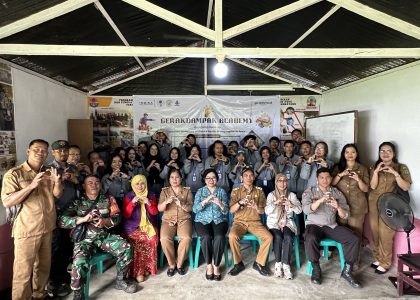
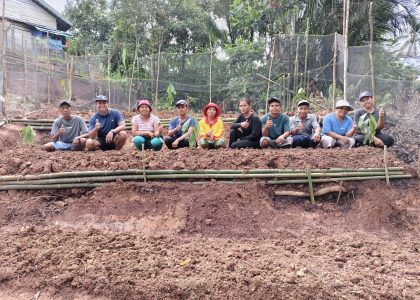
Pilot Project of Peatland Management for Sustainable Agriculture and Climate Change Adaptation which is jointly managed by farmer researchers, Mr. Subroto, Yayasan Swadaya Dian Khatulistiwa (YSDK), and Alumni Bisnis Cendekia IPB Kalbar received a visit from the Acting Governor of West Kalimantan, dr. Harisson, M.Kes in the context of a joint harvest activity of Edamame Bean Cultivation. This Field Meeting was attended by no less than 126 people, dominated by women. Acting. The Head of the Family Welfare Empowerment Movement Team (TP-PKK) of West Kalimantan Province, Mrs. Windy Prihastari Harisson, S.STP, MSi also attended with officials from various agencies at the West Kalimantan Province level such as the Regional Development Planning Agency, Regional Finance and Asset Agency, Inspector, Public Works and Spatial Planning Agency, Public Housing and Residential Area Agency, Food Security Agency, Food Crops and Horticulture Agency, Social and Community and Village Empowerment Agency, Marine and Fisheries Agency, Disporapar, and the Pontianak City Food, Agriculture, and Fisheries Agency. In addition to government officials, alumni associations from various universities such as KAGAMA Kalbar, IKA Unhas Kalbar, HA-IPB Kalbar, and students from Tanjungpura University were also present. Farmers around the location who work as peatland farmers, either as owner farmers, farm laborers, or vegetable traders also enlivened the visit. "If you plant leafy vegetables starting from sweet mustard greens, meatball mustard greens, bitter mustard greens, curly mustard greens, pakchoi, spinach to water spinach, it's finished," said Mr. Subroto, a farmer researcher who has been engaged in agricultural cultivation on peatlands for more than 40 years. "The knowledge is finished," said Mr. Subroto. On the other hand, cultivating edamame beans on peatlands is something new. It requires new knowledge. There are new challenges. It requires the latest technological innovation.

Acting Governor of West Kalimantan, dr. Harisson, M.Kes., was surprised to hear YSDK's explanation that the peatland in the demonstration plot location that has been managed for farming for around 25 years has never experienced land fires. One of the keys is the component of the ash hut as a place to make charcoal from weeds or grass that grow well in peatlands. This charcoal making is carried out in a controlled manner in the hut so that it does not cause land fires. This practice is one form of implementing adaptation to climate change by reducing the release of carbon into the air. The second component is the use of organic fertilizer from chicken manure as the main fertilizer so that farming on this peatland has moved towards organic farming practices even though it is still in the implementation stage of Low External Input Sustainable Agriculture (LEISA).

On that occasion, the Acting Governor of West Kalimantan, dr. Harisson, M.Kes., also had the opportunity to see firsthand the charcoal hut facilities managed by the Dian Khatulistiwa Swadaya Foundation which are also used as a production site for various types of fertilizers to support organic farming as well as a place of practice for farmers and interns. One of them is the manufacture of Liquid Organic Fertilizer (POC) from banana peels as a source of potassium which is the result of research by lecturers at the Faculty of Agriculture, Tanjungpura University. Other products on display are the manufacture of organic fertilizer from salted fish waste which is composted in a plastic drum and added with EM-4 decomposer. There is also shrimp skin waste in the form of flour which is also composted in a plastic drum container and given EM-4 decomposer. Other liquid organic fertilizers are made from old coconut skins soaked in plastic drums and used as a source of liquid potassium fertilizer as a result of research from the Bogor Agricultural Institute.

The Edamame harvest on peatlands by the Acting Governor of West Kalimantan this time was also enlivened by the handover of rice assistance to Islamic boarding schools and the underprivileged, followed by the handover of aid kits to toddlers suffering from stunting from the West Kalimantan Provincial Food Security Service. For the general public around the location who attended this harvest, a bazaar was also provided that provided cheap basic food packages in the form of 5 kg of rice, 1 kg of granulated sugar, and 1 kg of cooking oil at a price of Rp. 95,000 per package.

From this activity, we can learn various things related to good practices in peatland management for sustainable agricultural activities as well as being a form of local action for the global challenge of mitigating climate change.




 English
  Indonesian